
Your kids may be chatterboxes all day long, talking your ear off, yet when it comes time to pray, they are strangely shy. Why is this? What makes children feel awkward about prayer and how can we give them the language and tools to make them more comfortable? Teaching kids how to pray it’s important but it’s not always easy. Here we offer you some tips for teaching kids to pray, to help grow your family’s prayer life.
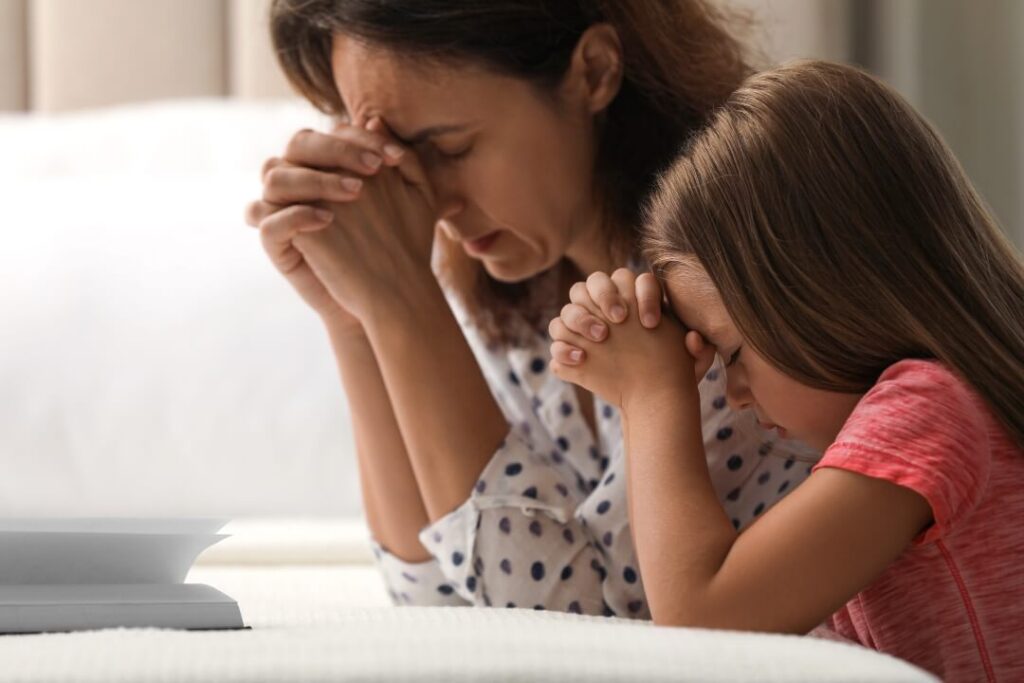
What Is Prayer? As parents we have conversations with our children every day. Praying to our heavenly Father should also be a natural, daily occurrence. it’s important to meet kids on their level, and give them the confidence to approach God and know they are being heard. Prayer is just a conversation with God, and it’s part of building an intimate relationship with our creator.
Why Do We Pray? Throughout history prayer has been an important part of faith. It helps us grow closer to God, it helps us live more faithful lives, and it strengthens our faith, allowing us to go out into the world and be a light to others. we pray to confess our sins, we pray to honor God and praise him, we pray to ask for help, and we pray to give thanks for all the blessings in our lives. We should always pray in sincerity, out of an earnest desire to connect with God. When we teach children to pray, we are teaching them to prioritize their relationship with God, which is an essential part of a life of faith.
How Should We Pray? The answer to this question is as varied as there are people on earth. Each person comes to God a little bit differently and that’s alright, because God made us all unique. The Lord’s prayer gives us structure, since it is Jesus’s answer when his disciples asked how to pray. (Matthew 6:9-13, and Like 11:2-4) While we often recite this verbatim, it’s meant to be an outline around which we can build our prayers. Giving little children structure that is meaningful to them can help them craft their own prayers.
- H.A.T with God. One way to teach children to pray is to give them the acronym chat. This stands for confession, honor, ask, thank, and it’s a reminder that praying is just a chat with God.
- For very little children, try these phrases. preschoolers won’t really understand an acronym, but they do understand phrases like “I’m sorry,” ‘I love you,” “please,” and “thank you.” Teach them to use these phrases as they pray.
- Prayers are found throughout scripture. Many people find it helpful to pray the prayers found in the Bible, changing pronouns or inserting their own names as is helpful to make it personal. Doing this with children serves 2 purposes. First it helps them learn to pray and become comfortable with prayers, and second, it puts scripture into their minds.
- Look for creative ways to help children pray. Provide bathtub crayons to write on the shower walls, or dry erase markers to write on the windows. Designate a place to put sticky notes with prayer requests on them. Encourage kids to pray for their family members, neighbors, friends, and for their own help and guidance. Teach them to pray “it’s not fair” prayers of lament, so that they can begin to understand that the world is not as God intended it to be and God loves us even when things are not right. Teach children to pray with prayer journals, with drawings, and even with stickers, letting them know that prayer need not be formal or public.
- Try a head to toe prayer. As kids point to their various body parts, connect each part to a facet of prayer. At the head, pray that the child would have the mind of Christ, at the eyes, that he or she would seek God and really see others. Ears are for hearing God’s voice, and mouths are for speaking the truth in love. Hands are for serving God by helping neighbors and friends, tummies remind us to thank God for our food, knees are for kneeling in prayer instead of trying to do everything on our own, and feet are for walking in God’s paths.
- How Are Prayers Answered? It’s important, also, to teach children that God is not a vending machine, and every prayer is not answered with a yes. Sometimes the answer may be no, and sometimes it may be wait. Teaching little ones to ask in faith and wait on God’s timing is important to their spiritual growth.
At CEF Norcal, we’re determined to share the Gospel in any and every space we can. Our missionaries are constantly on the lookout for new ways to reach children, whether by sharing the Gospel with families at local fairs, partnering with churches to do drive-through Gospel presentations, or hosting one-time party clubs in public schools. With your help, we believe that this year we’ll reach even more children for Christ. To learn more about the work we’re doing and how you can help increase the witness of our ministry, visit our website. Or consider volunteering with us or applying to be a hands-on missionary, a teacher, someone who helps support a local club, or a committee or board member.